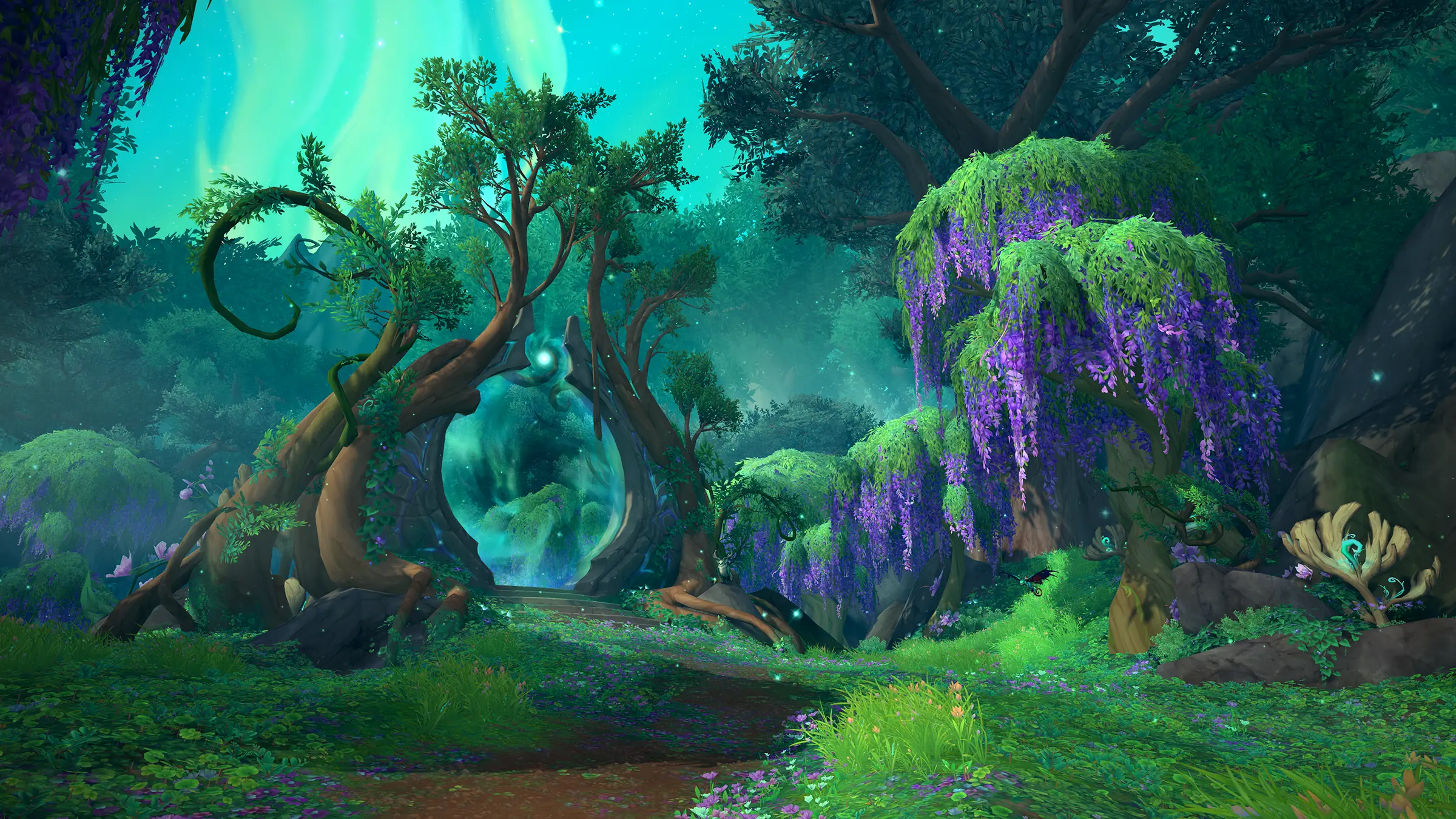
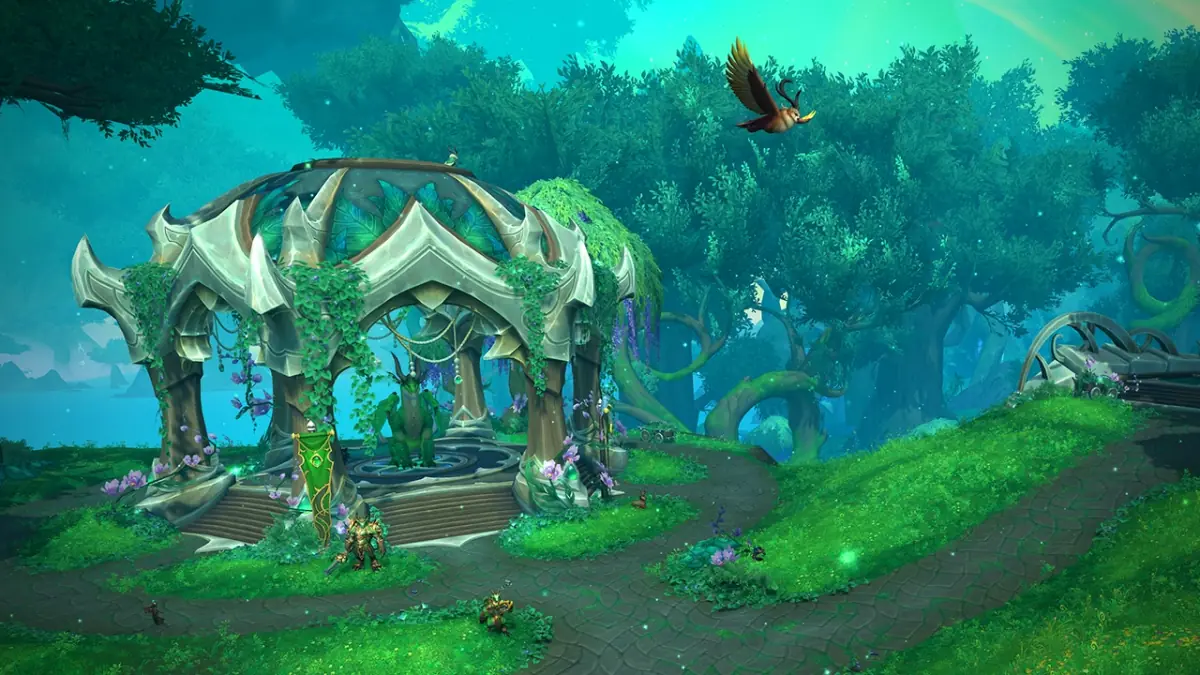
Where the dreamers go

In the old tales, the druids lie down beneath the boughs, and their spirits rise to walk a truer Azeroth, green and endless, where time forgets to pass. Blizzard once meant it as the place your hero went after death, free to wake again or simply stay. Here we follow the real science that may one day open that door for the rest of us.

Three secrets of the Dream

What the old tales already knew, and what our own world has learned so far.

The dreamform

The body stays behind, asleep and safe. What rises is still you, your face and your stride, walking a world that bends to thought.

Machines that listen to the brain already let people speak, write and steer by thought alone. Machines that could write a whole world back into the senses are still a dream of their own.

The place you could stay

In WoW's earliest designs, death was not an ending. Fallen heroes would wake in the Dream among the spirits of legend, free to find their way back, or to remain.

Uploading: charting a brain's wiring so faithfully that the mind within could go on living in a world of our making. So far, whole maps exist only for the smallest creatures, a worm and flies.

The Unwaking

Not every dreamer comes home. Those caught by the Emerald Nightmare cannot wake; their bodies sleep on while their minds wander, lost.

The hard questions: whether the one who wakes is truly you, who may give consent, and who holds the keys to the world you wake in.

Last walked September 14, 2026

Five roads into the Dream

No seer can name the day. But scholars have cast their guesses, and every road already has milestones behind it. Here is the honest map.

When might a human mind be copied?Four published guesses, laid along a single line of years. None of them is a promise.
Whole Brain Emulation Roadmap2008 · if computing trends alone decide
before 2050
Neuroscience Research projection2024 · a mouse around 2034, a marmoset around 2044
later than 2044
Metaculus forecastersCommunity forecast, Sept 14, 2026 · range 2040–2199
2067
Survey of 312 neuroscientists2025 · median guess
2125
Read our honest reckoning

No seer can name the day, and the scholars' guesses span a century. In 2008, Oxford's Whole Brain Emulation Roadmap reckoned from computing trends alone that emulating a human brain 'should be possible before mid-century', if electrophysiological-level models are enough. But it assumed Moore's law would hold and that computing was the hard part, and mapping and biology have proved the steeper climb. A 2024 projection in Neuroscience Research placed a cellular-level simulation of a whole mouse brain around 2034, a marmoset around 2044, and a human 'likely later than 2044'. In 2025, 312 neuroscientists surveyed for PLOS One gave median guesses of about 2045 for a worm, 2065 for a mouse and 2125 for a human, and the median among them gave only about 40% odds that a preserved brain could be emulated even in principle. On 14 September 2026, Metaculus's forecasters set the first full human emulation at September 2067, with guesses ranging from 2040 to 2199. The bridge of brain-computer interfaces is rising far faster: about 80 people carried an implanted BCI by mid-2025, and the first US pivotal trial of a permanent one is planned for 2026. Full-dive has no credible date from anyone. Our honest reckoning: within a few decades, expect implants that return speech, movement and some sight to those who lost them. Hold the uploading of a human mind as a late-century possibility at best, and no certainty at all.

The bridge between mind and machine is real, and people are crossing it in trials, though only a handful so far. A systematic review published in July 2025 counted 80 people worldwide with an implant for paralysis or lost speech, and Neuralink reported 21 trial participants in January 2026. Listening is the stronger half of the craft. Speech decoders have reached 97.5% word accuracy and can give a voice back with about a fortieth of a second of delay, and people steer cursors, tablets and games by intention alone. Speaking back into the brain is far cruder. Retinal and cortical implants return low-resolution sight in trials, and stimulating the touch cortex can let a paralysed hand feel again, but nothing yet approaches the senses we were born with. No implanted BCI has passed the FDA's full premarket approval; Synchron's planned pivotal trial is aimed at the first such filing.

  1. Jan 2024Neuralink's first human implant

    Neuralink implanted its first device in a man paralysed by a spinal cord injury, who went on to use it to play video games and chess.

    1 participantEuronews
  2. Aug 2024Speech BCI reaches 97.5% accuracy

    UC Davis researchers decoded the attempted speech of a man with ALS from a 125,000-word vocabulary and read it aloud in a voice built from his pre-ALS recordings.

    97.5% word accuracyUC Davis Health
  3. Sep 2024Synchron's six-patient safety trial succeeds

    In the first US trial of a chronically implanted BCI, all six patients met the 12-month safety goal with no serious adverse events involving the brain or blood vessels.

    6 of 6 patientsThe Robotics Media
  4. Jun 2025Real-time voice from brain signals

    A UC Davis system turned a man's attempted speech into synthesised voice with about a fortieth of a second of delay, letting him change intonation and sing simple melodies.

    ~60% of words understoodUC Davis Health
  5. Aug 2025Inner speech decoded, with a mental password

    A Stanford-led team decoded imagined speech in four people with paralysis and showed that a password phrase can keep private inner speech locked.

    4 participantsStanford Medicine
  6. Oct 2025Retinal implant restores reading vision

    In a 38-patient trial reported in NEJM, 80% of people blinded by geographic atrophy gained meaningful visual acuity from a tiny light-powered implant, and most could read letters and words.

    80% meaningful improvementScience Corporation
  7. Jan 2026Neuralink reaches 21 trial participants

    Two years after its first human implant, Neuralink said 21 people were enrolled in its trials worldwide, up from 12 using implants in September 2025.

    21 participantsReuters (via Yahoo News)
  8. Jun 2026Paradromics begins its speech trial

    Surgeons at University of Michigan Health implanted the first participant in Paradromics' FDA-approved Connect-One study of a wireless implant meant to restore communication.

    421 electrodesMichigan Medicine
Next on the road
Synchron plans the first US pivotal trial of a permanently implanted BCI in 2026, and Neuralink says it is ready for its first human Blindsight vision implant once regulators allow it.
The far shore
A safe, fully implanted, wireless link that lasts for decades and carries the world both ways, at the full bandwidth of our senses and muscles.
Whole wiring maps now exist for insects. The newest, a male fruit fly's brain and nerve cord, charts 166,700 neurons. Mammals, though, are still mapped one cubic millimetre at a time. The finest mammalian maps, a cubic millimetre of mouse visual cortex (523 million synapses) and a similar sliver of human cortex (about 150 million synapses), cover roughly a thousandth of a mouse brain and about 0.00007% of a human one. The cost has fallen like a stone, from an estimated $16,500 per reconstructed neuron for the first worm map to roughly $100 in recent zebrafish work. Yet imaging a whole human brain at synaptic resolution would still yield an estimated 2 to 2.8 zettabytes of data, and checking the AI's tracing by hand remains the narrowest pass on this road.

  1. 1986First connectome: the C. elegans worm

    Researchers traced every connection among the 302 neurons of a millimetre-long worm by hand, a job that took 16 years.

    302 neuronsGoogle Research
  2. Mar 2023First whole insect brain: the fruit fly larva

    The complete synapse-level wiring of a larval fruit fly brain was published in Science, the most complex whole brain mapped at the time.

    3,016 neurons, 548,000 synapsesMRC Laboratory of Molecular Biology
  3. May 2024A cubic millimetre of human cortex (H01)

    Harvard and Google reconstructed a tiny piece of human temporal cortex, removed during epilepsy surgery, at nanoscale resolution.

    ~57,000 cells, ~150 million synapses, 1.4 PBScience (via PubMed)
  4. Oct 2024Whole adult fly brain (FlyWire)

    The FlyWire consortium published the first complete wiring diagram of an adult fruit fly brain, an animal that can walk and see.

    139,255 neurons, 54.5 million synapsesScience News
  5. Apr 2025A cubic millimetre of mouse cortex (MICrONS)

    A consortium mapped a piece of mouse visual cortex and matched it to recordings of about 75,000 of its neurons responding to images.

    200,000 cells, 523 million synapsesMICrONS Explorer
  6. Oct 2025Protein barcodes for cheaper mapping (PRISM)

    E11 Bio showed that tagging neurons with unique protein 'barcodes' makes AI tracing nearly ten times more accurate, and says the approach could cut tracing costs 100-fold or more.

    ~10x tracing accuracyMedical Xpress
  7. Sep 2026A whole fly nervous system, eyes to legs

    The first complete connectome of a male fruit fly's brain and nerve cord, joined at the neck, was published in Cell after the equivalent of 44 years of human labour.

    166,700 neuronsMRC Laboratory of Molecular Biology
Next on the road
A first whole mammal. NIH BRAIN CONNECTS projects are imaging about 10 cubic millimetres of mouse brain (2–3% of it) to learn whether a whole mouse, some 70 million neurons, lies within reach.
The far shore
A whole human brain: about 86 billion neurons and an estimated 100–1,000 trillion synapses. A whole mouse brain, about 70 million neurons, is the next great step.

No creature has yet been emulated in a way the field agrees is faithful, not even the 302-neuron worm. What exists are models that echo pieces of behaviour: a whole-fly-brain model built from its wiring predicts which neurons drive feeding and grooming, and a startup has joined such a model to a simulated fly body. Sheer scale is no longer the tallest wall. A supercomputer has run a biophysically detailed model of a whole mouse cortex, and GPU clusters have run simplified networks nearing human-brain scale, but those are woven from averaged atlas data, not copied from any one living brain. The State of Brain Emulation Report 2025 names the true obstacles: the models are starved of data, key biology such as neuromodulation is still largely left out, and no one yet knows which details a faithful copy needs.

  1. 2011OpenWorm sets out to simulate a whole worm

    An open-science project launched to build the first detailed biophysical simulation of the nematode C. elegans, a goal it is still working toward.

    302 neuronsPhilosophical Transactions of the Royal Society B (via PMC)
  2. Sep 2024Wiring alone predicts fly vision

    A model built from the fly visual system's connectome plus the task of detecting motion predicted the activity of 64 neuron types and reproduced more than two dozen past experiments.

    64 cell typesHHMI Janelia Research Campus
  3. Oct 2024A whole fly brain, simulated from its wiring

    A simplified model of the adult fly brain, built from its connectome and predicted neurotransmitters, predicted the neurons that drive feeding and grooming, and the team tested those predictions in real flies.

    125,000+ neurons, 50 million synapsesNature (via PMC)
  4. Dec 2024Blue Brain Project closes

    EPFL's Blue Brain Project, which pioneered biologically detailed brain simulation, ended after running from 2005 to the end of 2024; a nonprofit foundation carried its tools on from 2025.

    ~20 yearsEPFL Blue Brain Project
  5. Nov 2025A whole mouse cortex on a supercomputer

    The Allen Institute and Japan's University of Electro-Communications ran a biophysically detailed model of an entire mouse cortex on the Fugaku supercomputer.

    ~10 million neurons, 26 billion synapsesAllen Institute
  6. Mar 2026A fly brain model gets a virtual body

    Startup Eon Systems connected a whole-fly-brain model to a physics-simulated fly that walks, grooms and feeds; the company notes many brain-body links were chosen by hand and the internal dynamics are not yet validated.

    ~140,000-neuron modelEon Systems
Next on the road
Faithful copies of small creatures come first. The State of Brain Emulation Report 2025 calls for 'detail-first' work in worms, larval zebrafish and flies, and the Allen Institute says it is moving toward simulating an entire mouse brain.
The far shore
A simulation of one particular brain that behaves as the original did: a worm, then a fly, then a mouse, and one day a human brain of about 86 billion neurons.

Form can be kept; function, so far, cannot be brought back at any scale. Aldehyde-stabilized cryopreservation (ASC) has held every synapse visible across whole rabbit and pig brains. But it begins by fixing the brain with chemicals, which the Brain Preservation Foundation itself describes as death by today's standards and which makes biological revival exceedingly impractical; scanning and emulation are the only imagined way back. Nectome has posted a version meant to follow physician-assisted death. On the side of true sleep, a 2026 PNAS study woke working synapses, long-term potentiation among them, in vitrified mouse brain tissue, though in slices rather than living animals. Whether a preserved structure still holds a person is unproven: in a 2025 survey, neuroscientists' median estimate that an ASC-preserved brain keeps enough to decode some long-term memories was 41%.

  1. Feb 2016Whole rabbit brain preserved, synapses intact

    The Brain Preservation Foundation awarded its Small Mammal Prize for aldehyde-stabilized cryopreservation, which kept connectivity intact across an entire rabbit brain.

    1 whole rabbit brainBrain Preservation Foundation
  2. Mar 2018Whole pig brain preserved

    The same method, scaled up, won an $80,000 prize for preserving a pig's brain so well that every synapse could be seen with an electron microscope.

    $80,000 prizeMIT Technology Review
  3. Jun 2025Neuroscientists weigh in on preserved memory

    In a survey of 312 neuroscientists, the median estimate that an ASC-preserved brain retains enough information to decode some long-term memories was 41%.

    41% median estimatePLOS One
  4. Mar 2026Vitrified mouse brain tissue comes back

    German researchers vitrified mouse hippocampal slices and whole brains, stored them for up to about a week, and after rewarming recorded working synapses - in tissue, not living mice.

    stored up to 8 daysScientific American
  5. Mar 2026Nectome adapts ASC to physician-assisted death

    Nectome posted a preprint, not yet peer reviewed and written by company employees, adapting ASC for use after physician-assisted death, demonstrated in pigs.

    whole pig brainsbioRxiv
Next on the road
Carrying reversible vitrification from mouse tissue to human tissue and whole organs. The Erlangen team reports early signs of viability in human cortical tissue, but says better solutions and rewarming methods must come first.
The far shore
A whole human brain kept with every synapse intact, ideally in a sleep it can wake from, and proof that what makes a person survives the keeping.

It does not exist, and no one has published a credible timeline for it. Full-dive would mean writing every sense into the nervous system at natural resolution, while catching every intention to move and keeping the body still. Today, eyes and ears are still reached from outside, and most haptics only buzz; Northwestern's 2025 actuator, which can push, stretch and twist the skin, is a step past that. Writing directly into the brain happens only in medical trials. A cortical vision implant with 544 electrodes aims to help blind volunteers navigate and manage basic visual tasks, while the eyes normally send the brain millions of nerve signals. Stimulating the touch cortex lets a paralysed hand feel, and has now proved safe across a combined 27 implant-years. Taste has been delivered chemically, with about 70% accuracy for simple distinctions. Our honest reckoning: decades, at the very least.

  1. Oct 2016A paralysed man feels touch through his brain

    Pitt researchers stimulated Nathan Copeland's sensory cortex so he could feel touch through a robotic arm he controlled with his brain, as natural sensation rather than tingling.

    first in humansScienceDaily (University of Pittsburgh)
  2. May 2021Artificial touch halves robot-arm task time

    Adding brain-stimulated touch feedback let a man with tetraplegia grasp and move objects with a robotic arm in half the time.

    20.9 s to 10.2 sUniversity of Pittsburgh
  3. Feb 2022First wireless cortical vision implant

    Surgeons implanted 25 miniature wireless stimulators into the visual cortex of a blind volunteer in Illinois Tech's Intracortical Visual Prosthesis trial.

    400 electrodesIllinois Institute of Technology
  4. Feb 2025Taste sent over a network (e-Taste)

    Ohio State's e-Taste released taste chemicals on digital command, even triggered from California to Ohio; testers told sour intensities apart about 70% of the time.

    ~70% accuracyOhio State News
  5. Mar 2025Haptics beyond the buzz

    Northwestern engineers unveiled a wireless skin actuator that can push, stretch, slide and twist the skin in any direction instead of just vibrating.

    force in any directionTechXplore (Northwestern University)
  6. May 2026Cortical vision implant scales to 544 electrodes

    The Intracortical Visual Prosthesis trial's third blind participant received 34 wireless stimulators, aimed at helping with navigation and basic visually guided tasks.

    544 electrodesIllinois Institute of Technology
  7. Jul 2026A decade of touch stimulation shown safe

    Pitt and UChicago reported 168 million stimulation pulses across five volunteers with no serious adverse events, and sensations that stayed mapped to the hand.

    27 implant-yearsUniversity of Pittsburgh School of Medicine
Next on the road
Neuralink's Blindsight vision implant awaits approval for its first human, and the Pitt–UChicago touch team says its safety record means industry can begin building take-home sensory devices.
The far shore
Sight, sound, touch, balance, taste and smell delivered directly at natural resolution, every intended movement caught and the body kept safely still, for hours at a time.

Every milestone names its source. Follow any of them and judge for yourself.

1 written

Chapters so far

Gathered every few minutes

Whispers from the waking world

What stirs in the labs, gathered from the world's science news. Each headline leads back to the hands that wrote it.

  1. Fly Brain Connectome Used To Trade Stocks And Play Games
  2. Brain-computer interface enables avatar speech and gestures for people with paralysis
  3. 'I Have a Lot to Say': Austin Brain Implant Helps Patient Communicate in Real Time
  4. Google’s AI-Mapped fruit fly brain has tried "Doom" 6,000+ times without winning— Here's...
  5. China approves 3rd medical device standard for brain-computer interface
  6. Fly Brain Successfully Connected to ChatGPT in Groundbreaking Experiment
  7. Female Biology PhD Preparing to Ring the Bell - Academic Milestone Moment
  8. Stonkfly turns a virtual fruit-fly nervous system toward crypto trading
  9. Fly Language Model (FLM) Wires the Full Fruit Fly Connectome Into a Frozen 1.2B LLM, and Its Own Controls Show the Wiring Does Not Help
  10. Completing the Connectome: How Pursuing a Map of the Fly Brain Rewired Neuroscience | Newswise
  11. Bitcoin's Weirdest Trader Yet? Fly Brain Makes a Profit
  12. A Fruit Fly’s Disembodied Brain Is Now Trading Bitcoin on Coinbase
  13. Google Mapped A Fruit Fly Brain, So Engineers Taught It To Play Doom
  14. Steinbrenner Scholar Brings Lived Experience to Brain-Computer Interface Research
  15. Researchers Unveil Complete Fruit Fly Connectome
  16. Tether Evo’s latest research addresses one of the biggest challenges in brain-computer interfaces
  17. Butterfly Network, Merge Labs partner on ultrasound brain-computer interfaces
  18. AI visionary Ray Kurzweil is joining a Silicon Valley startup developing a brain computer system that involves snorting nanoparticles
  19. China ramps up brain computer interface push
  20. Butterfly Network (BFLY) Is Down 9.5% After Exclusive Brain-Computer Interface Chip Licensing Deal
  21. Colleague Skill: an attempt at distillation and mind uploading
  22. Why some human brains can outlast other soft tissues after death
  23. What If David Chalmers’s “Hard Problem” of Consciousness Isn’t Real? | by Tim Ventura | Jul, 2026
  24. Low Plasma Vitamin C Linked to Lower Gray Matter and Neural Network Gaps
  25. 'Sword Art Online' Inspired VR Headset Kickstarter Delayed by "a few days", Reveal Video Here
  26. A Surprising Number of U.S. Doctors Believe Brain Preservation Could Actually Work
  27. Neurosurgeons Are Weirdly Optimistic About Cryonics for Life Extension, Survey Finds
  28. Doctors say there is a 25% chance a frozen brain or body could be revived in the future: survey
  29. Miracell Demonstrates Cognition Impairment and Brain Function Improvement in Severe Alzheimer's Patients Using 'SMART M-CELL'-Based CD34+ Cell-Rich Autologous Blood Concentrate Therapy
  30. Could This AI-Simulated Brain Lead to Human Mind-Uploading?
  31. Can the Brain Survive Cryonic Sleep?
  32. Sam Altman Among 25 People on Waitlist for 'Fatal' Brain Preservation That Will Keep Them Digitally Immortal
  33. Scientist Thawing Out Fragments of His Friend’s Cryogenically Preserved Brain
  34. Mind uploading closer than ever as scientists freeze brain in time
  35. Researchers Upload Fly’s Brain to Matrix, Let It Control Virtual Body
  36. The First Multi-Behavior Brain Upload

The Unwaking

Every dream has a nightmare side.

To love the dream honestly is to name its shadows too: whether the one who wakes is truly you, who may choose to go, and what it means when the world you live in belongs to a company. We will not look away from them.

Read about the Unwaking