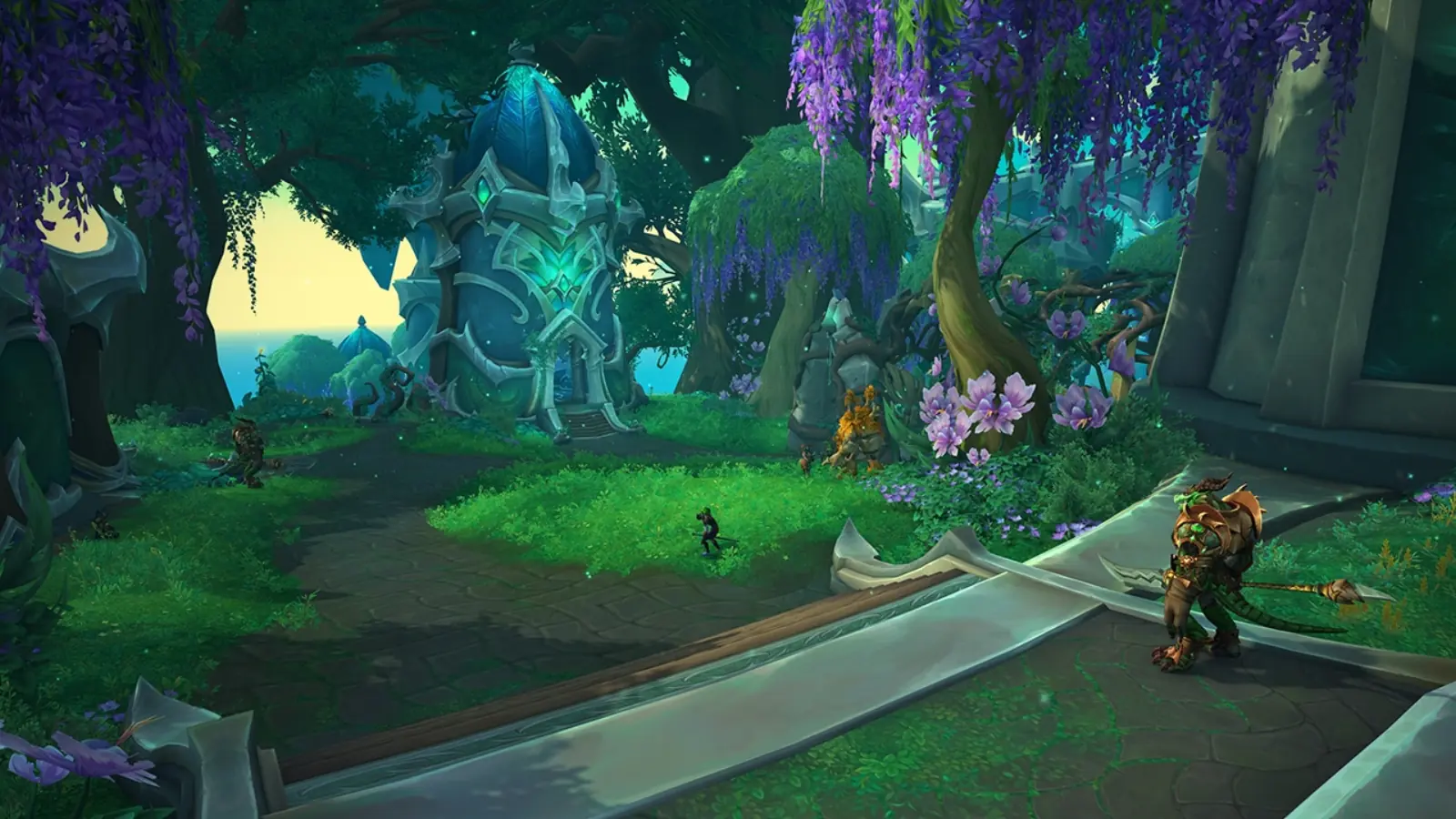
The Long Road to Azeroth
Three roads lead toward a living Azeroth: brain interfaces, copied minds and the long sleep. An honest map of how far each has come.
In the old stories of Azeroth, a druid can lie down beneath the boughs, let the body sleep, and walk the Emerald Dream. The self that makes that journey is called a dreamform, and it looks and behaves much as the sleeper's body would, carried through a greener, older likeness of the world. A few, the lore tells us, never went home: they kept living in their dreamforms after their bodies had died.
Anyone who has loved that world knows the pull of that story: not to visit Azeroth through a pane of glass, but to be there. To stay.
That hope deserves better than hype, so what follows is an honest map, drawn by lantern-light. Every figure is tied to its source, and every road is marked plainly: what has been done, what is being tried in human trials, and what is still only a dream.
Three roads into the Dream
There are three ways in, and they do not lie equally far away.
The waking bridge keeps your body and builds a crossing between it and the world. Its first spans already stand; at its far end waits full-dive, with sight and sound and touch written straight into the nervous system while the body lies still.
The copy road asks for something stranger: to chart a brain's wiring, every thread of it, and run that chart on a machine as a working mind. Scholars call it whole-brain emulation, or uploading, and it needs two great labours, not one: the map, and the waking of the map.
The long sleep is less a road than an inn along the way: a brain preserved so well that if the copy road is ever finished, there is still something left by the hearth to copy.
The waking bridge
Already done, in human trials. This road has already carried travellers: implanted brain-computer interfaces (BCIs) work. A systematic review published in July 2025 counted 80 people across the world who had received one for paralysis or the loss of speech. Neuralink, which implanted its first participant in January 2024, said this January that it had 21 people enrolled in its trials. They are people living with spinal cord injuries, ALS and strokes, and what they have been given back is real.
Reading signals out has run fastest. In 2024 a team at UC Davis decoded the attempted speech of a man with ALS at 97.5% word accuracy, across a vocabulary of 125,000 words. In 2025 the same group synthesized his voice with about a fortieth of a second of delay, quick enough for him to interrupt, change his intonation, and sing a simple tune. Sit with that: a man whose illness had taken his speech, singing.
Synchron's implant, threaded into place through a blood vessel, met its 12-month safety goal in all six patients, and the company plans the first US pivotal trial of a permanently implanted BCI this year. In June, Paradromics implanted the first participant in its speech trial.
Barely begun. Carrying the world back into the brain is far cruder work. Illinois Tech's cortical vision implant reached its third blind participant in May: 544 electrodes, meant to help with navigation and basic visual tasks. A healthy brain, the project notes, takes in millions of nerve signals from the eyes. Against that flood, 544 is a handful of candles in a very large dark.
Still, the candles are lit. A retinal implant called PRIMA brought meaningful vision gains to 80% of patients in a 38-person trial. Stimulating the touch cortex lets paralyzed people feel sensations in their hands, and researchers at Pitt and UChicago have delivered 168 million pulses over a combined 27 implant-years without a serious adverse event. In January, Elon Musk said Neuralink was ready for its first human implant of Blindsight, a cortical vision device, pending regulators.
Still only a dream. Full-dive, every sense at full resolution all at once, exists in no lab. Even outside the skull, artificial touch is only now learning to do more than buzz: Northwestern's 2025 skin actuator can push, stretch and twist. No one has published a credible timeline for full-dive. Our honest reading is decades, at the least.
Charting the Dream
Where the waking bridge keeps the body, the copy road lets it go, and its first task is cartography.
Already done. Complete maps exist, so long as the creature is small. The first, the 302 neurons of the worm C. elegans, was traced by hand and published in 1986, after 16 years of work. The first whole insect brain, a larval fly's 3,016 neurons, followed in 2023. In 2024 the FlyWire consortium mapped an adult fly brain: 139,255 neurons and 54.5 million synapses. Earlier this month came a male fly's brain and nerve cord together: 166,700 neurons from eyes to legs, the equivalent of 44 years of human labour.
Still in progress. Mammals are mapped a single cubic millimetre at a time. The MICrONS project's cubic millimetre of mouse visual cortex holds 200,000 cells and 523 million synapses: about a thousandth of a mouse brain. Harvard and Google's cubic millimetre of human cortex, from tissue removed during epilepsy surgery, holds about 57,000 cells and 150 million synapses and fills 1.4 petabytes.
A whole human brain holds about 86 billion neurons, and the State of Brain Emulation Report 2025 estimates that imaging one at synaptic resolution would produce 2 to 2.8 zettabytes of data. That is not a map. It is a continent.
One lantern burns in that dark: cost. Reconstructing each neuron of the worm cost an estimated $16,500. In recent zebrafish projects it has fallen to roughly $100, and new methods such as E11 Bio's protein barcodes aim lower still. The next honest milestone is a whole mouse brain, roughly 70 million neurons. The report estimates that imaging one within five years would take 40 to 50 of the high-speed electron microscopes used in a current NIH project, all running in parallel.
The dreamform
A map, however fine, is only parchment. The copy road's second labour is to make it wake.
Done, in part. Maps are beginning to behave like brains. In 2024 a model of the whole adult fly brain, built from its wiring and predicted neurotransmitters, picked out the neurons that drive feeding and grooming, predictions the team then tested in real flies. It is simple enough to run on a laptop. In March, the startup Eon Systems attached a fly-brain model to a simulated body that walks, grooms and feeds, while cautioning that many of the links between brain and body were chosen by hand, and that the model's inner dynamics are not yet validated.
Not done. No creature has yet been emulated in a way the field agrees is faithful. Not even the worm, whose 302 neurons the OpenWorm project has been working to simulate since 2011.
Raw scale is no longer the great wall. Japan's Fugaku supercomputer has run a biophysically detailed model of a whole mouse cortex, almost 10 million neurons and 26 billion synapses, and GPU clusters have run simplified networks approaching human scale. But those models are built from atlases and averages, not copied from any one animal. They are portraits of no one.
The State of Brain Emulation Report names the real walls plainly: models remain "severely data-constrained," biology such as neuromodulation is "still largely omitted," and nobody knows yet which details a faithful copy needs.
The long sleep
And if the roads are not finished in time? Then there is the long sleep: a brain kept safe, the way a traveller binds a hearthstone to an inn, against the day the road is done.
Done. Structure can be preserved. Aldehyde-stabilized cryopreservation (ASC) won the Brain Preservation Foundation's prizes for a whole rabbit brain in 2016 and a whole pig brain in 2018, with every synapse visible under an electron microscope. But the method begins by flushing the brain with a chemical fixative, which the foundation's own announcement says means death by today's standards and makes biological revival "exceedingly impractical." The only imagined way back is scanning and emulation. This is not the sleep of druids; if anything returns from it, it returns as a copy.
In March, Nectome, co-founded by the method's lead researcher, posted a preprint adapting it for use after physician-assisted death, demonstrated in pigs.
Early. Reversible preservation is still at the tissue stage. In March a German team reported in PNAS that vitrified mouse brain tissue, stored for up to about a week, came back with working synapses, including the long-term potentiation that underlies learning. It was tissue, not a living mouse, but something frozen came back still able to do the work of learning.
Unknown. Whether a preserved brain still holds the person who lived in it. In a 2025 survey of 312 neuroscientists, the median estimate that an ASC-preserved brain retains enough to decode even some long-term memories was 41%. Less than a coin toss.
What must hold true
For anyone to open their eyes in Elwynn Forest, several things must all come true at once:
- Memory and personality live in physical structure we can capture: the wiring, the strength of each synapse, and whatever finer molecular detail turns out to matter.
- That structure can be mapped across 86 billion neurons, affordably, without destroying what it encodes.
- How each part behaves can be read from the map, then run fast enough to live inside.
- Or, on the waking bridge, every sense can be written into a living brain at its natural bandwidth, safely.
Ask the seers when, and their answers span a century. The 2008 Whole Brain Emulation Roadmap concluded from computing trends alone that, if electrophysiological models are enough, human emulation "should be possible before mid-century." It assumed Moore's law would hold; the 2025 report now calls data, not processing power, the more fundamental limit. A 2024 projection places a cellular-level simulation of a mouse brain around 2034 and a human one "likely later than 2044." The median neuroscientist in the 2025 survey guessed 2065 for emulating a mouse and 2125 for a human. On Metaculus, the community forecast for the first full human brain emulation stood at September 2067 on the day we published.
Read them like stars through cloud: informed guesses, not promises. No seer can name the day.
The Unwaking
Every dream has its shadow. Travellers who stray into the Emerald Nightmare can become trapped: they cannot leave, and their bodies back on Azeroth stay in a permanent sleep. The lore calls them the Unwaking. It fits the problems no finer microscope will solve.
Is it you? An emulation built from a scan would remember your life: every road you walked, every friend you made. Whether it would be you, or someone new who only believes it is, is a question science cannot currently test. And preservation by fixation ends the original, so there would be no one left to compare it with.
Consent. Today, the only road to a well-preserved human brain runs through death. When Nectome first pitched its service in 2018, its co-founder told MIT Technology Review the product was "100 percent fatal." Its 2026 protocol is built around physician-assisted death. That places enormous weight on consent, and on who is allowed to ask for it.
Privacy. A Stanford-led team that decoded imagined inner speech in 2025 warned that it could accidentally "leak out" into a speech decoder, and demonstrated safeguards. In November 2025, UNESCO member states adopted the first global ethics framework for neurotechnology, naming privacy and consent over neural data as central concerns. The mind has always been the one room without a window; it matters who gets to look through the first one.
Who owns the servers. A digital Azeroth would be Blizzard's world, running on Blizzard's machines. Under the current Blizzard End User License Agreement, your use of the platform is "licensed, not sold," and Blizzard can terminate access for serious violations. That is a reasonable bargain for a game. It would be a very different bargain for a mind. Before anyone makes a home on a server, someone must answer the oldest question in any kingdom: who holds the keys, and who may put out the lights.
A world built for staying
Which brings us back to the game.
Blizzard revealed World of Warcraft: Forever at BlizzCon on September 12. It launches November 4, built as "a new permanent home alongside modern and Classic WoW." One of its four pillars is the world as the main character. Players will be staying at level 60 indefinitely, and Blizzard's recap says it is "not a mode, a season, or a new version of Classic."
The What's Next panel's pitch for the new Riverglades zone held a line fit to carve above this site's door. In Output Lag's transcription, which Wccftech attributes to Lead Classic Designer Tim Jones: "This isn't a story about saving Azeroth, it's a story about living in Azeroth."
That is the right shape for a world meant to be lived in: one never swept away by the next expansion, one that prizes the journey over the race to the cap, one built around other people, the campfire and the crowded inn. Forever is still a game on a screen, but it is an Azeroth made, on purpose and out loud, as a place to stay.
Where the dream stands tonight
So where do we stand, at the edge of the map?
Dozens of people now control computers through implants, and a few speak or feel again. We can chart a fly's whole nervous system and run a rough copy of its brain. We can preserve a pig's synapses and revive activity in vitrified mouse tissue. None of it yet works for a human mind, and the median neuroscientist in that 2025 survey put the odds of building an emulation from a preserved brain, even in principle, at 40%.
That distance is not a reason to stop dreaming. It is a reason to dream carefully: to fund the slow, unglamorous science; to insist on consent, and on knowing who holds the keys; and to keep an honest map. We will keep this one current as the roads move.
Until then, the Dream waits where it always has, just past the edge of sleep. Some of us mean to find the way in.
Sources
- Wowpedia: Emerald Dream
- Wowpedia: Dreamform
- Dohle et al., Advanced Science (2025): systematic review of implantable BCIs
- Euronews: Neuralink implants its eighth and ninth participants (July 2025)
- Reuters: Neuralink says it has 21 participants enrolled in trials (January 2026)
- UC Davis Health: speech BCI with 97.5% accuracy (August 2024)
- UC Davis Health: real-time voice synthesis (June 2025)
- Clinical Trials Arena: Synchron's COMMAND feasibility trial
- The Robotics Media: Synchron's 2026 pivotal trial
- Michigan Medicine: first Paradromics Connect-One implant (June 2026)
- Illinois Tech: third Intracortical Visual Prosthesis implant (May 2026)
- Science Corporation: PRIMA results in NEJM (October 2025)
- University of Pittsburgh: decade-long safety of touch stimulation (July 2026)
- India TV News: Neuralink ready for first Blindsight implant (January 2026)
- TechXplore: Northwestern full freedom-of-motion haptic actuator (March 2025)
- Google Research: ten years of connectomics and the H01 human cortex map
- MRC Laboratory of Molecular Biology: larval fruit fly connectome (2023)
- Science News: all 54.5 million connections in a fruit fly's brain (2024)
- MRC Laboratory of Molecular Biology: male fly CNS connectome (2026)
- MICrONS Explorer: cubic millimetre dataset
- Princeton University: mapping the connections that allow mice to see (2025)
- Shapson-Coe et al., Science (2024): a petavoxel fragment of human cortex
- Zanichelli et al.: State of Brain Emulation Report 2025
- Medical Xpress: E11 Bio's PRISM protein barcodes (2025)
- Shiu et al., Nature (2024): a Drosophila computational brain model
- Berkeley News: an entire fly brain simulated on a laptop (2024)
- Eon Systems: how the embodied fly was produced (2026)
- Sarma et al., Phil. Trans. R. Soc. B (2018): OpenWorm overview
- Allen Institute: whole mouse cortex simulation on Fugaku (2025)
- Brain Preservation Foundation: Small Mammal Prize
- MIT Technology Review: a mind-uploading service that is '100 percent fatal' (2018)
- Brain Preservation Foundation: Large Mammal Prize
- bioRxiv (Nectome, 2026): whole large mammal brain preservation compatible with physician-assisted death
- Scientific American: activity revived in frozen mouse brains (2026)
- Zeleznikow-Johnston et al., PLOS One (2025): survey of neuroscientists on memory
- Sandberg & Bostrom (2008): Whole Brain Emulation: A Roadmap
- Igarashi, Neuroscience Research (2024): projections for mammalian whole-brain simulation
- Metaculus: date of first human whole brain emulation
- Wowpedia: Emerald Nightmare
- Stanford Medicine: decoding inner speech (August 2025)
- UNESCO in the UK: first global framework on neurotechnology ethics (2025)
- Blizzard End User License Agreement
- Blizzard: Carve a New Path with World of Warcraft: Forever
- Blizzard: World of Warcraft: Forever What's Next panel recap
- VICE: World of Warcraft Forever revealed at BlizzCon 2026
- Output Lag: the Riverglades in World of Warcraft: Forever
- Wccftech: World of Warcraft: Forever launching November 4
Around the fire
Speak kindly. Wardens tend this fire, and cruelty is put out.
No one has spoken yet. The first words are yours.